


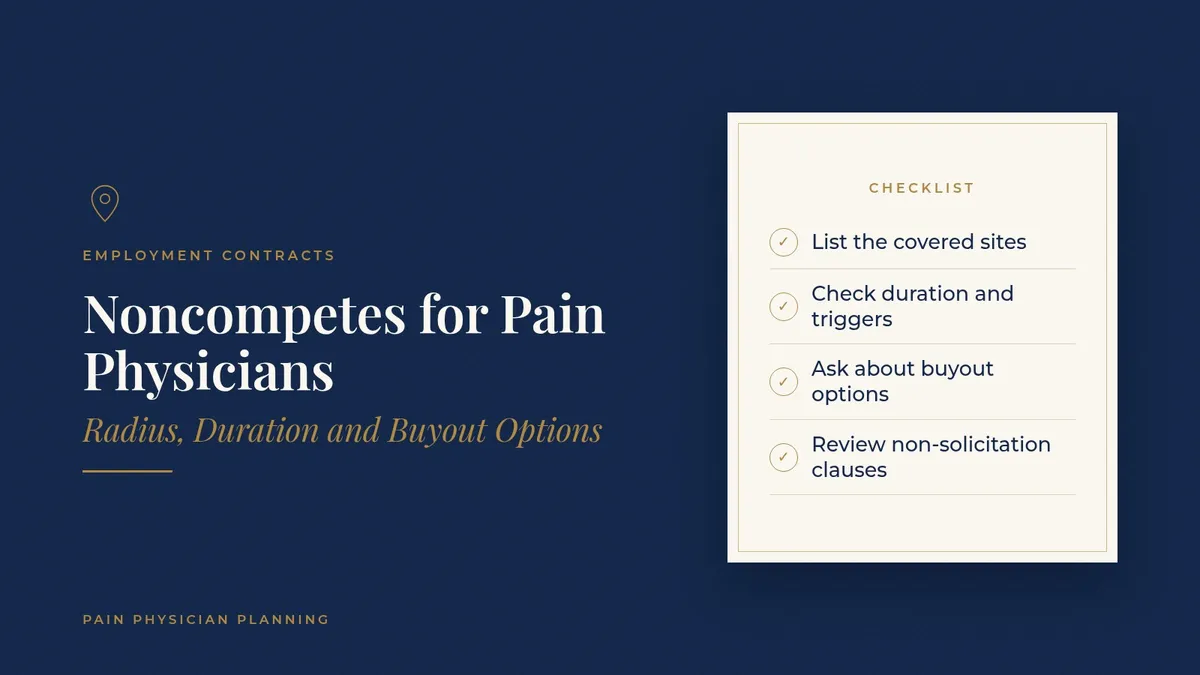
Noncompetes for Pain Physicians: Radius, Duration and Buyout Options
A pain management non-compete can shape your career long after you leave a job. For interventional pain physicians who work across a clinic, a hospital, and one or more surgery centers, the way a restrictive covenant defines distance, time, and covered sites decides where you can practice next, which referral relationships you can keep, and how disruptive a move will be for patients in active treatment.
This article explains how noncompetes in pain medicine are usually structured, how radius, duration, and buyout terms work, and why state law matters so much. It is general education only. Enforceability depends on your state and your specific agreement, so an attorney licensed in your state should review your situation.
Key takeaways
A pain doctor noncompete radius is usually measured from specific locations, so the list of covered sites matters as much as the mileage.
Duration, the triggering events, and whether the covenant applies after termination without cause all affect how restrictive it is.
Some states require or allow a buyout of a physician noncompete, and several states now ban or limit physician noncompetes.
Non-solicitation clauses for patients, staff, and referring physicians can matter as much as the noncompete itself.
Review usually happens before signing, and again before giving notice, with an attorney licensed in your state.
How a pain management non-compete is usually structured
Restrictive covenants in pain medicine tend to share the same building blocks. Understanding each piece makes the overall restriction easier to evaluate.
The restricted activity
Some covenants bar the practice of medicine in general. Others restrict only pain medicine or interventional procedures, or only services that compete with the employer. A narrow definition can leave room for academic work, telehealth, or a different practice setting.
The restricted area
The geographic limit is usually a radius or a list of counties. The key question is where it is measured from.
The time period
Duration usually runs from the last day of employment. Longer periods are generally harder to justify, but reasonableness depends on state law and the facts.
Who is protected
Some covenants protect only the employer. Others extend to affiliates, which can include every location owned by a health system or a private equity platform.
Radius: why covered sites matter more than miles
Measured from which locations
A short radius measured from every clinic, surgery center, and hospital where an employer operates can restrict far more territory than a longer radius measured from one office. Interventional pain physicians often rotate among sites, so it helps to know whether the radius applies to locations where you actually practiced or to every site the employer owns.
Future sites and acquisitions
Some agreements cover locations the employer opens or acquires later. In a fast-growing group, that can expand the restricted area after you sign.
Procedure sites and privileges
Pain physicians often perform epidurals, radiofrequency ablation, and spinal cord stimulator trials at an ambulatory surgery center or hospital. A covenant that names those facilities may affect where you can hold privileges after leaving.
Duration and the events that trigger it
When the clock starts
Most covenants start at separation, but some start when a contract term ends or when a transition period finishes.
Termination without cause
A key question is whether the covenant applies if the employer ends the relationship without cause, or if the contract is not renewed. State law and the agreement can treat these situations differently.
Sale or change of control
If the practice is sold, the agreement may allow the employer to assign the covenant to a buyer. Our guide to reading a pain management physician employment contract covers assignment and other exit terms.
Buyout options and state rules
What a buyout clause does
A buyout clause allows a physician to be released from the noncompete in exchange for a payment, often set by formula or negotiation. The amount and the method are deal terms, and your CPA can explain any related accounting questions.
States that require or limit physician noncompetes
State law varies widely. Texas, for example, has long required physician noncompetes to include a buyout option, and its legislature amended the statute in 2025 to add further limits for physicians. Several other states ban or restrict physician noncompetes, and some courts review them closely for reasonableness. A 2024 federal rule that would have banned most noncompetes was blocked in court and is not in effect, though federal agencies have said they may still challenge specific agreements. Because these rules change often, current law should be checked by an attorney licensed in your state.
Continuity of care
Many states and professional standards also expect patients to be told how to continue care when a physician leaves. In pain medicine, patients on ongoing medication management or with implanted devices may need a clear plan, which is usually coordinated with counsel.
Non-solicitation clauses for interventional pain physicians
Patients
Patient non-solicitation clauses limit outreach to patients you treated. Agreements often address what notice the practice will send and who controls patient lists.
Staff
Staff clauses restrict hiring nurses, medical assistants, or advanced practice providers who worked with you.
Referring physicians
Pain practices depend on referrals from spine surgeons, orthopedic groups, neurologists, and other physicians. Some agreements restrict soliciting those referral sources. Even a narrow non compete for interventional pain physicians may be paired with a broad referral clause, so read both together.
Questions to bring to a pain doctor contract review
Physicians commonly ask counsel questions like these:
Which locations does the radius cover, and does it include future sites?
Does the covenant apply if I am terminated without cause or my contract is not renewed?
Is there a buyout option, and how is it determined?
How do the non-solicitation clauses define patients, staff, and referral sources?
Can the covenant be assigned if the practice is sold?
What does current law in my state say about physician noncompetes?
If you are also weighing an ownership track, our article on pain management partnership options explains how covenants often appear in partnership documents too. You can also read more about business attorney introductions for pain physicians.
Frequently asked questions
Are pain management noncompetes enforceable?
It depends on state law and the agreement. Some states ban or limit physician noncompetes, while others enforce reasonable restrictions on time, area, and scope.
How is a noncompete radius measured?
Usually from one or more named locations. The covered sites, including surgery centers and future locations, often matter more than the number of miles.
Can I buy out a noncompete?
Some agreements include a buyout option, and some states require one for physicians. Whether one applies to you depends on your contract and state law.
Does a noncompete apply if I am let go without cause?
It depends on the wording and state law. Some agreements and states treat termination without cause differently, so the specific terms should be reviewed.
When should a pain physician have a noncompete reviewed?
Physicians commonly seek review before signing, before renewing, and before giving notice, so they understand their options before making commitments.
Request an introduction
Request an introduction to an independent business attorney who works with pain management practices. To get started, take the 2-minute Partnership & Practice Planning Check. You can also call or text (972) 616-4581, or contact us. The form goes to [email protected].
This article is general information, not legal advice. PPP is an introduction service and is not a law firm. Please read our disclaimer.



